
Find Useful Blog Posts...
What are Financial KPIs and Why Do They Matter For Your Business
Imagine driving with your eyes closed. You’re moving, but you have no idea where you’re headed or whether you’re seconds away from a collision. That’s what running a business without tracking your financial KPIs (Key Performance Indicators) feels like.
Tracking income and expenses is important, but it doesn’t tell the full story. Financial KPIs reveal what’s working, what’s not, and where your attention should go if you want to grow strategically. They help you understand the true health of your business beyond what your bank balance shows.
In this post, we’ll break down what KPIs are, why they matter, and the essential ones every small business should start tracking today.
What is a Financial KPI?
A financial KPI (Key Performance Indicator) is a measurable value that shows how well a company is achieving its key financial objectives.
Unlike raw metrics, KPIs are tied to strategic goals and give you insight into performance relative to those goals. Think of metrics as puzzle pieces, while a KPI is the complete picture you see when those pieces fit together. One number alone can’t guide your business, but a well-chosen KPI reveals patterns, performance, and direction.

Why KPIs Are Critical For Any Business
1. They Measure the Health of Your Business
Financial KPIs show whether your business is stable, profitable, and sustainable. They help you spot patterns and trends you may miss when relying on intuition alone.
2. They Enable Informed Decision-Making
Instead of guessing, KPIs let you base decisions on facts. Want to increase revenue? Reduce expenses? Expand your team? KPIs tell you if you can afford it or if it’s too risky.
3. They Help You Spot Opportunities and Risks Early
A sudden rise in expenses? Slowing sales? Declining cash flow?
KPIs expose issues early enough for you to fix them and reveal opportunities before your competitors notice them.
Key Financial KPIs to Track
There are dozens of financial KPIs, but most of them fall under profitability, liquidity, efficiency, valuation and leverage categories.
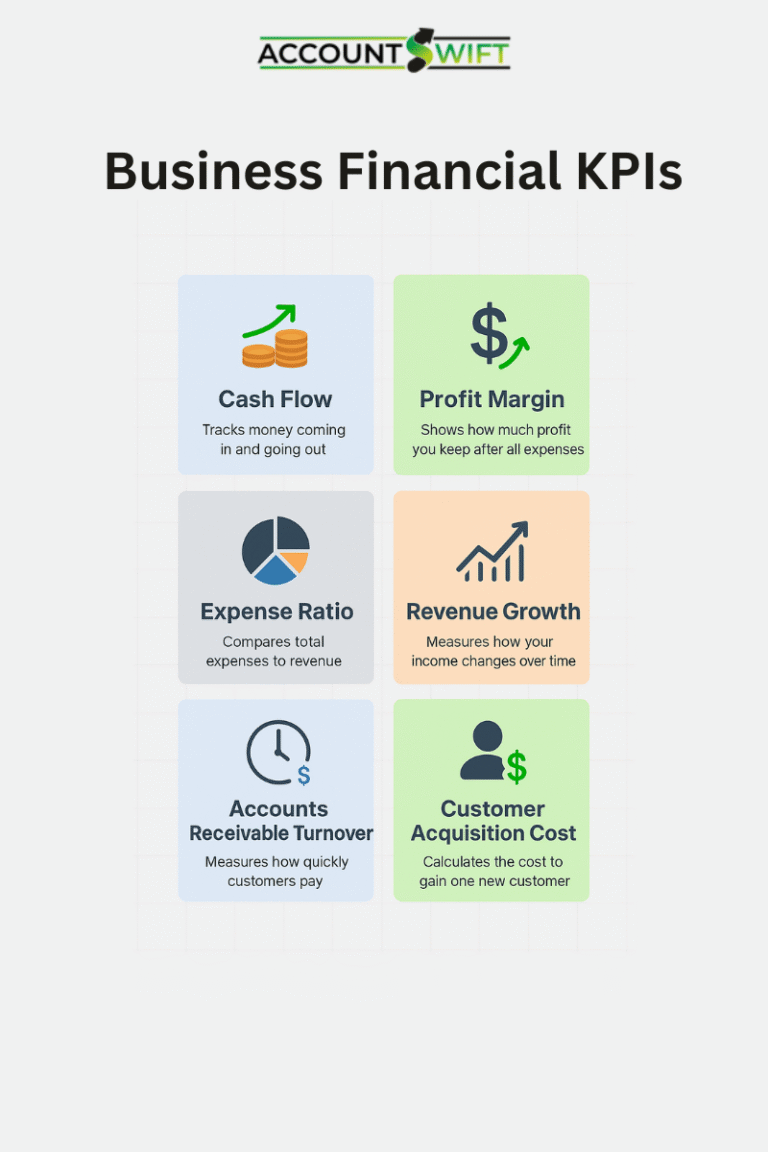
Here are six essential indicators for every business:
1. Cash Flow
Cash flow tracks the money coming in and going out of your business. Positive cash flow means your business can pay its bills, invest in growth, and weather challenges. It is the most important indicator of day-to-day financial stability.
2. Profit Margin
Profit margin reveals how much profit you make after expenses.
- High margins mean strong pricing and efficient operations.
- Low margins may signal overspending or underpricing.
3. Expense Ratio
Your expense ratio compares total expenses to total revenue. It tells you if your spending is controlled or eating into your profits.
4. Revenue Growth
This KPI shows how your income is increasing (or decreasing) over time. Consistent revenue growth is a strong sign of demand, operational efficiency, and customer loyalty.
5. Accounts Receivable Turnover
This measures how quickly customers pay you.
- High turnover = customers pay on time, healthy cash flow.
- Low turnover = delays that can choke your operations.
It’s a key metric for businesses offering credit or invoicing clients.
6. Customer Acquisition Cost (CAC)
This is essential for budgeting and scaling. It tells you the total cost (marketing, salaries, etc.) required to gain one new paying customer.
How Often Should You Review KPIs?
Your KPI review frequency depends on your business stage and goals.
- Daily: Cash flow, sales, expenses
- Weekly: Accounts receivable, revenue numbers, operational costs
- Monthly: Profit margins, growth trends, expense ratios
The key is consistency. Monitoring the right indicators at the right intervals keeps your strategy aligned with your goals. For example, if you’re in a growth phase, monitor revenue and CAC more often. If stability is the priority, cash flow and expenses come first.
Common Mistakes Business Owners Make
1. Ignoring Small Numbers
Small fluctuations often become major problems. A slight drop in margin or a slow-paying customer can affect cash flow more than you think.
2. Tracking Too Many KPIs
Tracking everything leads to information overload. Focus only on KPIs that directly impact profitability, stability, and growth.
3. Not Using KPIs to Drive Decisions
KPIs are useless if they aren’t applied. They should be used to guide actions like cutting costs, adjusting pricing, improving marketing, or optimizing operations.
Using Tools to Track KPIs Efficiently
Tracking KPIs manually or using spreadsheets is slow, time-consuming, and prone to error. What modern businesses need is automation, accuracy, and speed.
Tools like Account Swift automate the entire process. Your transactions sync automatically, KPIs are calculated in real time, and everything is displayed on a clean, easy-to-understand dashboard—so you can make decisions faster and with confidence.
Stop guessing and start knowing your numbers. Get started with Account Swift to track your financial KPIs effortlessly and make smarter business decisions.

Account Swift Team
Account Swift is the all-in-one platform that automates your finances, simplifies inventory tracking, and delivers the insights you need—effortlessly.